
Written by Gamze
Why didn't I learn this earlier?
Sometimes I wonder why no one explained this to me before. While studying psychology, I was given plenty of information to process: lectures, literature, assignments. But what no one taught me was how to store and use that information in a smart way. We were taught how to learn, but not how to organise our knowledge.
It wasn't until years later, on an ordinary Sunday afternoon at my desk, that I discovered Obsidian. A tool that showed me immediately: that's how it can be done. No more endless folders, lost notes or frustration about which document was where. Just: overview. Structure. Peace of mind.
What frustrated me for years
I am someone who likes to learn, and I was always able to adapt reasonably well to new systems. But it continued to struggle. Google Docs, OneDrive, Notion, iCloud, calendars that didn't talk to each other. I tried all sorts of things, but it always felt like I was tying up loose ends. I lost more time organising information than using it.
At one point, my head was overflowing. Too many sources, too many systems, too little overview. It felt like I was working mentally with sticky tape. Until I discovered Obsidian: a place where I could create my own structure, exactly in the way that suited me.
From loose notes to coherence
For me, what makes Obsidian different from other tools is that it is not about collecting, but connecting. Notes automatically link to each other, with no extra effort on your part. No more separate documents, but a network of thoughts. And that network just grows with you.
The nice thing is: you don't have to choose between overview or depth. You can write down ideas without immediately knowing where they belong, Obsidian helps you make those connections automatically later. That gives space. In my head and in my work.
Not a perfect solution, but a smart approach
Obsidian doesn't solve everything, and there is a learning curve for a while. But it did help me use my knowledge better. I have to search less and can find back what I was thinking, reading or writing more quickly. That gives peace of mind. And focus.
And perhaps most importantly, it helps me enjoy thinking, writing and learning again. Not because I have to, but because it feels logical again.
In conclusion
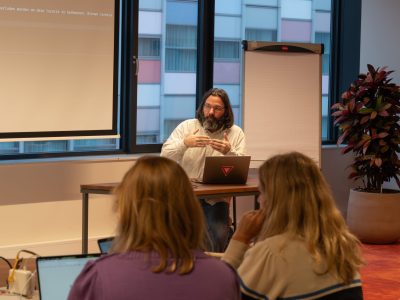
Obsidian is a very practical way for me to create order out of the chaos of information. And for me, it makes a big difference. The inspiring sessions of Obsidian expert Martijn Aslander, organised by Wonders of Work, gave me the final push to really get into it.